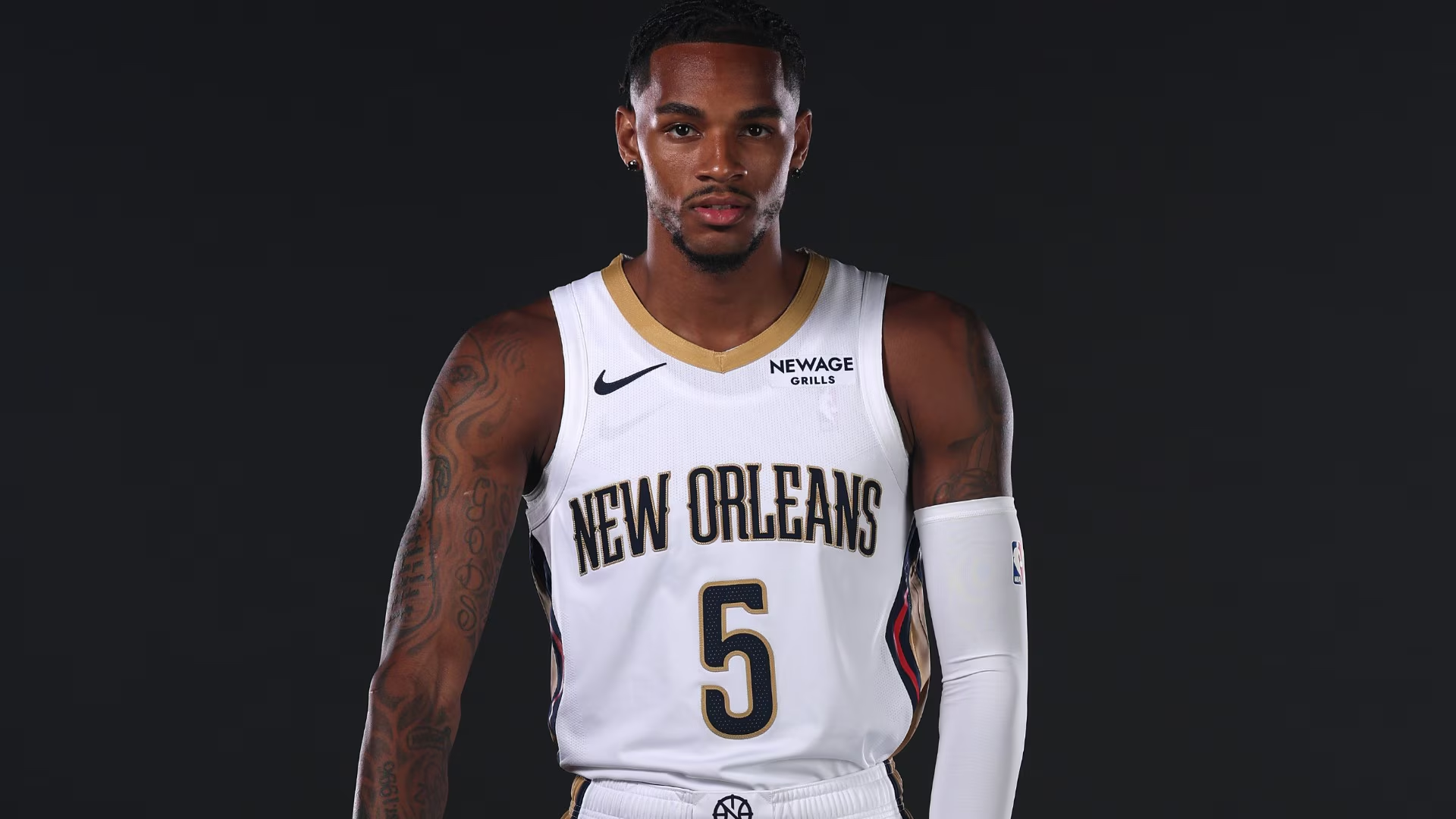
After more than a year away due to injury, Dejounte Murray is back with a fresh perspective on life.
Editor’s Note: Read more NBA coverage from The Athletic here. The views on this page do not necessarily reflect the views of the NBA or its teams.
***
Dejounte Murray felt heavy. And each passing day felt heavier than the last. “A dark cloud” hovered above him, he says. Refusing to dissipate, the cloud enveloped his thoughts, his emotions.
“Everything,” Murray says, “was just dark.”
It was June 2024. The Atlanta Hawks had just traded him to New Orleans.
There had been so much excitement in the air; hope for him to help turn around the Pelicans franchise by creating a formidable trio alongside Zion Williamson and Brandon Ingram. Everything had been going well even before his change of scenery. Almost too well, he now surmises, looking back on this moment. Murray had been averaging a career high in points in Atlanta after receiving a hard-earned All-Star nod with San Antonio in 2022. From the outside, it seemed as if a new opportunity next to other young stars could lead him back to All-Star status in New Orleans.
But each time he left the Pelicans’ practice facility, finally alone with his thoughts, his reality, he felt a crushing pain. “A lot of people don’t know,” Murray says, “a lot of stuff in life went downhill.”
First, his mother had a stroke, a week before his first game of the 2024-25 season. He flew to see her in Seattle, where he grew up. She could barely speak, helpless in the hospital.
Then he broke his left hand in the first game, causing him to undergo surgery and miss 17 games.
Then his cousin was killed.
Then his uncle suffered an overdose.
And then, in January 2025, he suffered a season-ending ruptured right Achilles tendon.
“Enough was enough,” Murray says.
The sequence was beyond eerie — and unlike anything he had experienced before in what should have been a rosy point in his career. Since being drafted at the end of the first round by the Spurs in 2016, Murray steadily worked to improve his game, brimming with potential as a high-scoring threat. And when he was traded to Atlanta in June 2022, shortly after his All-Star breakthrough, he wanted to prove he could take on an even bigger role, forming a backcourt duo with franchise star Trae Young. His production remained high, but the team never took off.
Once he joined the Pelicans, navigating one devastating blow after the next in his personal life, the weight sometimes felt too heavy to bear. “It was literally the worst three months of my professional career on and off the floor,” Murray says. “I was never able to focus on basketball.”
He finally let himself feel the weight of it all — and unload his grief.
“It was a breakdown,” Murray says.
He didn’t stay down for long. Murray had no choice but to be resilient; he didn’t know how to operate any other way. He knew he had to find a way out of his darkness, even if that meant somehow reaching up and lifting the cloud himself. His entire life has been about beating improbable odds, since growing up in a tough neighborhood in Seattle, forced to operate like an adult at age 11, uncertain of his future. Each new day felt like a miracle. He’s always felt most comfortable in the middle of the storm, drenched, arms open. “I’ve been going through obstacles since I was like 5 years old,” he says.
And now, emerging from the darkness that surrounded him in New Orleans, where even a medical professional questioned his ability to bounce back at all, he is finally ready to play after a year-long rehab journey with one of the toughest injuries in sports.
Murray is probable to return Tuesday for the Pelicans’ game against the Golden State Warriors.
He’s looking forward to showing a new, even more battle-tested version of himself. “Being able to just show the world,” Murray says, “that you could go through any obstacle in life and you could come out on top, better than you ever did — ever.”
When Murray, 29, speaks, his determination is palpable. He’s overflowing with excitement. Possibility. “I have so much basketball, and great basketball, ahead of me,” he says. “I’m so excited. I have a lot that I want to do.”
His teammates can sense his optimism. “He’s such a resilient dude,” says Williamson, his two-time All-Star teammate and New Orleans’ franchise centerpiece. “Not too long after the injury happened, his energy was already up. He was like, ‘Yeah, I’m going to return sooner than they think, sooner than people think. I’m gonna come back and make an impact.’”
Murray is ending up returning right around the projected recovery time.
“He hasn’t missed a step,” Williamson says. “It isn’t surprising at all because the whole way, he’s been locked in.”
Murray isn’t bitter about what has happened to him. Far from it. “It’s all something I look back and smile about,” he says. He isn’t being hyperbolic; Murray tried to show up to rehab each day with a smile — with the mindset of finding joy anywhere he could.
“It’s a beautiful struggle,” he says. A struggle that caused him to continue to look inward. As he recounts his journey back to basketball, he finds himself unintentionally traveling back in time, talking about his past. Before the NBA, before anyone knew his name. The more he reveals, the more time begins to blur. One minute, he’s speaking about his Achilles injury in New Orleans; the next, his mind shifts back to Seattle. To his childhood, teenage years. To the parts that he tries not to think about.
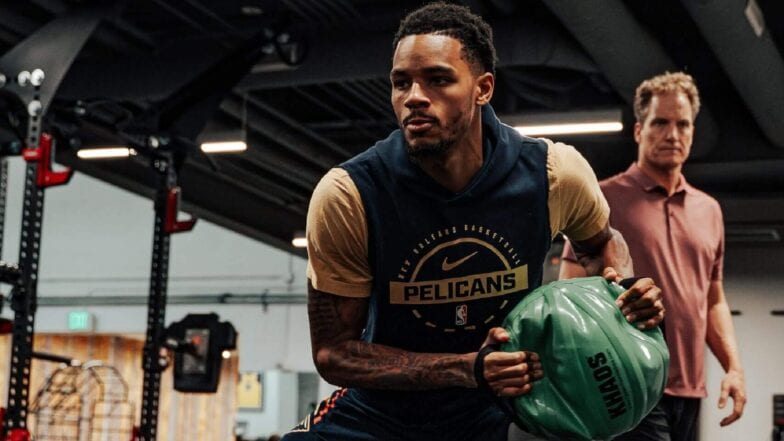
“I’m gonna get up every single time,” Dejounte Murray says of his recovery from a ruptured Achilles — and whatever else may come. Photo courtesy of Klutch Sports
He was raised by his grandmother, surrounded by gun violence, gangs and drugs. Sometimes, he slept in a sleeping bag on the floor. He was caught up in the wrong crowds. When he was 11 years old, he was arrested for a robbery with a firearm. He served time in juvenile detention as a teen. He is reminded each day of what he left behind, often calling family members and friends still in prison.
He sees his Achilles injury as just one more thread woven into the larger fabric that is his life: a familiar but painful pattern of overcoming. And he realizes, too, that he is on a journey that is deeper than his comeback to the NBA.
“I’m trying to find myself,” Murray says.
Murray is nearing an age at which one often contemplates life through new lenses. It causes one to think about where one has been, where one wants to go; what one has been through.
“I am healing,” Murray says. Not just physically — from his injury — but from everything he had endured in the months leading up to the rupture. And everything before that. It is a lot to untangle. A perpetual processing. “You can’t put a timetable on these things,” he says. “I don’t know when I’m just going to be, ‘Oh, OK! I’m healed now!’ … I bottled up so much.
“I was never even able to really live a regular life. And people won’t never understand that, you know what I’m saying? Since I was 7, 8 years old, there was nothing regular about the things I was involved in, around or nothing. … So, I’m still trying to even find myself.”
He pauses, contemplating a question he has asked himself repeatedly over this past year of healing:
“Who is Dejounte, really?”
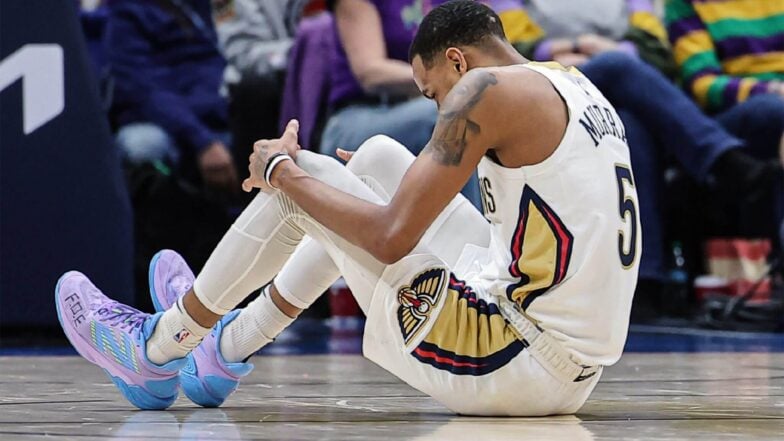
After Murray ruptured his Achilles in January 2025, one doctor expressed skepticism that he’d ever return to play NBA basketball, he said.
He remembers the moment the injury happened. On Jan. 31, 2025, in a game against the Boston Celtics, Murray dribbled the ball around the top of the key, weaving around several defenders. He drove to the lane, releasing an off-balance shot. He missed, but as he retrieved his own rebound, he stumbled and fell to the floor.
He grabbed his right foot, wincing in pain. But in true Murray fashion, he immediately forced himself up, rather than wait for assistance, and hobbled to the baseline.
It was devastating, but given how things had been going before his move to New Orleans, he couldn’t help but wonder if part of this was meant to somehow humble him. “I was seeing so much good and having so much success,” Murray says, “And it was just like, trying to remind me that I’m human, not a machine, not a robot, not different to any human in the world, besides what I do for a living.”
He tried to comfort himself by reminding himself that he has gone through much worse. “I’m somebody that carries a lot on my shoulders,” he says. “I carry it by myself. I get through it.”
That has always been the rhythm of his life: Endure. Endure. Survive. Survive. But with each family death, and finally with his injury, he struggled to comprehend it all. A person of faith, Murray searched for clarity. “I’m asking, like, ‘Damn. Why is all of this happening back-to-back?” Murray says.
Playing basketball was how he usually soothed any kind of pain. But now, he no longer had that comfort to rely on. He could no longer walk without his boot and crutches. “I had that breakdown. It was quick. It was simple, as crazy as that sounds,” he says. “But I’m somebody that moves forward. Life goes on. And you’re gonna either stay down on the ground, or you’re going to get up.
“And I’m gonna get up every single time.”
Achilles injuries are some of the most difficult to recover from, but Murray didn’t think about any of that. He soon got down to work, believing he would be more than OK. Others weren’t as certain. He says he’d encounter strangers who would look at him, full of pity, staring at his boot and crutches. “That type of s— motivates me,” he says.
So did the difficulty of rehab. “It was tough in the beginning,” he says. Movements he could easily do before the injury without thinking were no longer possible. It was about two months after his surgery when he realized he couldn’t do a single calf raise. Murray, a high-flyer who could explode past a defender, rise and dunk over someone, couldn’t do a single calf raise.
He’d try again, bracing himself, pulling with seemingly every muscle in his foot and his leg, to summon his body to raise onto his toes, but couldn’t do it. It was demoralizing — but he kept trying, failing, refusing to quit — especially after one interaction with one doctor. The doctor was stunned that Murray couldn’t complete the calf raise. “He looked at me like it was the end of the world,” he recalls. “Like, ‘Nah, you’re not playing basketball.’
“The energy was more, ‘Oh no. It could be over.’”
As in, his basketball career. That was something Murray refused to accept. Not after everything he had gone through in Seattle on his way to the NBA. And that’s exactly where his mind returned to when he heard the doctor’s comment. It reminded Murray of the pessimism he hopscotched over so many times. “The energy, I don’t like being around that,” he says. “I grew up around crime, violence and negativity my whole life. I’m more on the side of tell me the truth. I don’t care if it’s good or bad … What’s the alternative? … How are we gonna get through this? What’s the plan?”
As Murray continued working hard in rehab, he relied on wisdom he picked up from a previous injury, when he tore his right ACL in a preseason game before the 2018-19 season, his third season in the league, back when he was with the Spurs.
So this time, remembering how that felt, he made sure to still be there for his teammates. “He would be locked in on group messages,” Williamson says. “He’d be texting guys, calling guys … text our team group messages, like, ‘Hey guys, saw the game … good W’ or ‘Hey bounce back, keep your heads up. We’re going to get through this bump in the road.’ He was always active throughout the whole journey.”
Williamson and other teammates noticed how dedicated Murray was in his rehab. Murray kept laboring on his calf raises and other once-familiar movements, embracing where he was rather than lamenting where he had hoped he’d be. “Everybody’s bodies [are] different. There might have been a guy that could do [a calf raise] after two, three months. That’s him. That’s not me,” he says. “I have nothing to prove to nobody. I made it out of something that’s really, really almost damn near impossible.”
He is here, but he is there. Back in Seattle. What is a calf raise to someone who saw people he loved taken by bullets, one by one, before age 10? What is one doctor’s opinion to someone who faced jail time before receiving his driver’s license? He holds within him a carousel of almosts — almost didn’t make it. Almost lost everything. “What I carry day in and day out,” Murray says, “is knowing that I just got to prove me right.”
Growing up, he developed a tunnel-vision kind of focus, hoping for a different life, pushing himself each day to become the best basketball player he could.
That mentality led him to play a year of college basketball at the University of Washington in 2015-16 before being drafted by the Spurs. And it was the same mentality he used to approach his Achilles rehab all these years later.
He focused on what he could control, but it wasn’t easy. It never is, for the myriad NBA players who have recently suffered Achilles injuries, including fellow All-Stars Jayson Tatum, Tyrese Haliburton and Damian Lillard. Each day of recovery tugs at one’s most vulnerable thoughts. Fears; injuries force one to confront past versions of oneself. Ghosts; one wonders if he is still the same player. But what is more daunting is imagining a future version of oneself, a version that has yet to be born. Will he be the same player? Will he be as explosive?
But instead of focusing on what he might lose, Murray focused on what he was gaining: more mental toughness, more resilience.
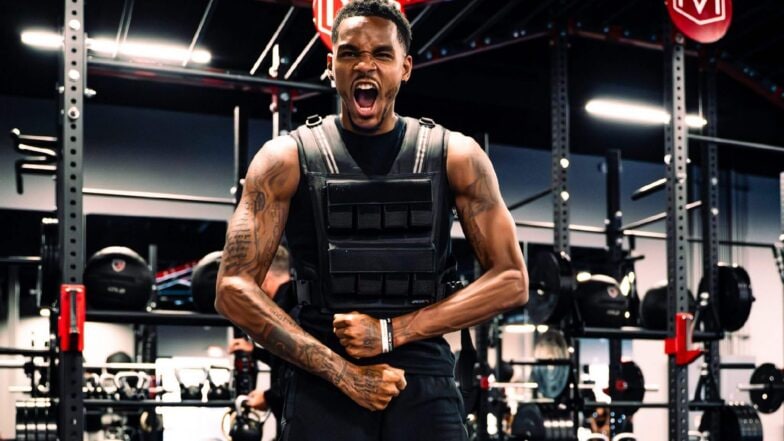
Murray calls coping with the totality of what he’s lost in life “the beautiful struggle.” Photo courtesy of Klutch Sports
He continued to tend to his grief, too, honoring the memory of those he has lost. His cousin, other family members. Friends. He chooses to find “beauty,” he says, in his pain, no matter how difficult, remembering those who did not have the same opportunities as he does now.
“That’s the beautiful struggle,” Murray says. “The struggle was looking back and reminiscing about where I came from and how many people I lost and who’s not here to celebrate all these good things and great things and memories with me today.”
Who is Dejounte, really?
“What makes Dejounte really happy? What doesn’t make Dejounte happy?” he says. “It’s great to be able to even have that thought process, because I come from an environment where you don’t have time to think.”
Endure. Endure. Survive. Survive.
Back then, as a child, he had no time to contemplate happiness. And maybe that helped him get here — to the NBA — by bottling up everything and performing at the highest level in the world. But maybe, he is realizing, he can find new ways to operate. To succeed without living in survival mode.
As the months passed, and he began to return to the court, he also contemplated what success truly meant to him. “Success is: You woke up today,” Murray says. “You get a chance to go do something great — whatever you do.”
“It doesn’t have to be rich and famous. It could be making it out of your environment. Having a consistent job. Having a consistent roof over your head. Making sure your kids are going to school every day,” Murray says. “This right here, millions of dollars and mansions, that’s not real. That’s not reality, really. I try to keep myself knowing the main goal … what really matters in life.”
What matters, he knew, was so much more than basketball — as much as he loves the game; as excited as he is to return for the Pelicans. But temporarily losing hoops further reinforced his values and sharpened his focus: “Success is all these little things that has nothing to do with the NBA or basketball, because that doesn’t define me.”
As he takes the court Tuesday against Golden State, looking up at all of the people in the stands, people who paid just for a chance to see him and his teammates play, he is reminded of his purpose. His struggles — those that none of these people see.
“A lot of people in the world that watch these professional athletes, they think we’re just not human,” he says. “We got money, success … you play basketball, hockey, baseball, whatever it is, and you’re not allowed to be normal. You’re not allowed to be like us, the regular people.
“But when we’re done playing these professions, guess who we are? Regular people,” he continues. “We still are humans. We still are you.”
He lets out a smile.
Who is Dejounte, really?
A son. A father. A friend. A teammate. A basketball player. Someone who is perpetually searching.
***
Mirin Fader is a senior writer for The Athletic, writing long-form features, primarily on the NBA. Mirin is also the New York Times best-selling author of GIANNIS: The Improbable Rise of an NBA Champion and DREAM: The Life and Legacy of Hakeem Olajuwon. She has told compelling human-interest features on some of our most complex, most dominant heroes from the NBA, NFL, WNBA and NCAA, most recently at The Ringer. Her work has been featured in the Best American Sports Writing books. She lives in Los Angeles. Follow Mirin on Twitter @MirinFader