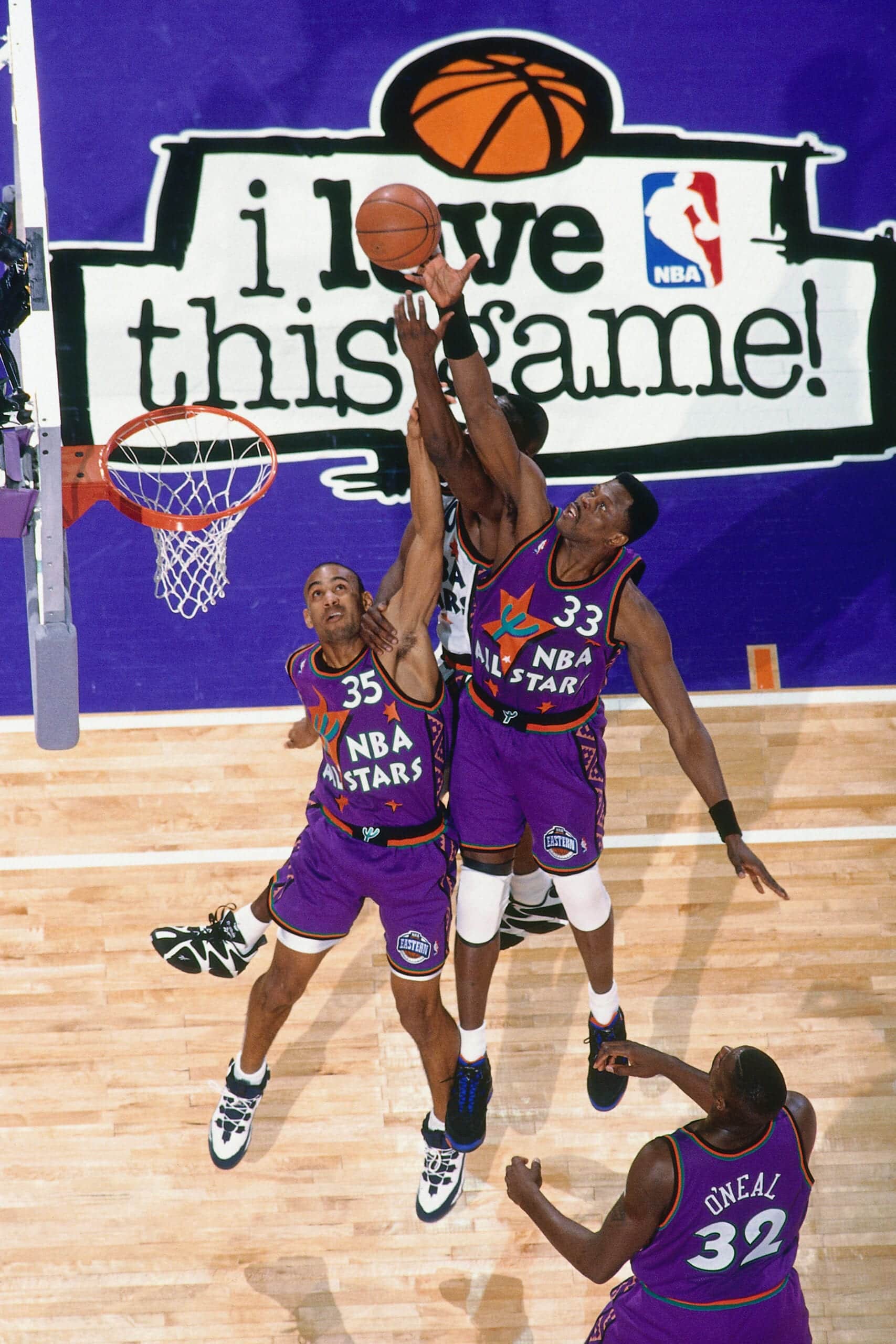
Those intent on tracing the origins of the NBA All-Star Game will be led all the way back to the mid-winter of 1950-51, to the 80th floor of the Empire State Building, and down the hall to room 8023.
It was in that room, during an informal meeting between three men deeply invested in the professional game’s growth and stability, that the idea for the mid-season classic was first raised.
Room 8023 was, at the time, the league’s humble headquarters. It was quaint, quiet and gave no indication it was the hub for a major sports league, or at least one that aspired to be. It was the office of league commissioner Maurice Podoloff and his publicity director, Haskell Cohen. Their visitor on that day was Celtics president Walter Brown, and with his team in town to play, it afforded him his regular visit to head office, where the three gathered to discuss the affairs of their infant league – its state, its health, its prospects.
The brainstorming session, as it invariably did, turned to the eternal struggle of driving fan interest, and it was then that Cohen rather innocuously suggested a one-off All-Star game. It had been successfully launched in both baseball and football, he rightly motioned, and now anticipated annually.
Brown, who had fought tooth-and-nail to keep his Celtics alive in this, their fifth season, was immediately intrigued and, without hesitation, offered Boston to host without regard to potential financial loss. They both turned to Podoloff. Taking a moment, he agreed the concept had potential, but he would need serious convincing.
Fast forward to the 15th day of January in 1951, and Podoloff stood before an assembled group of newspapermen at the Hotel Lenox in Boston to announce that soon his league would be playing its first All-Star Game. The game’s greatest players, he proudly stated, would be assembled on one floor for the ultimate showcase. Forty-six days later, in the Boston Garden, that vision was realized – and the event has never looked back.
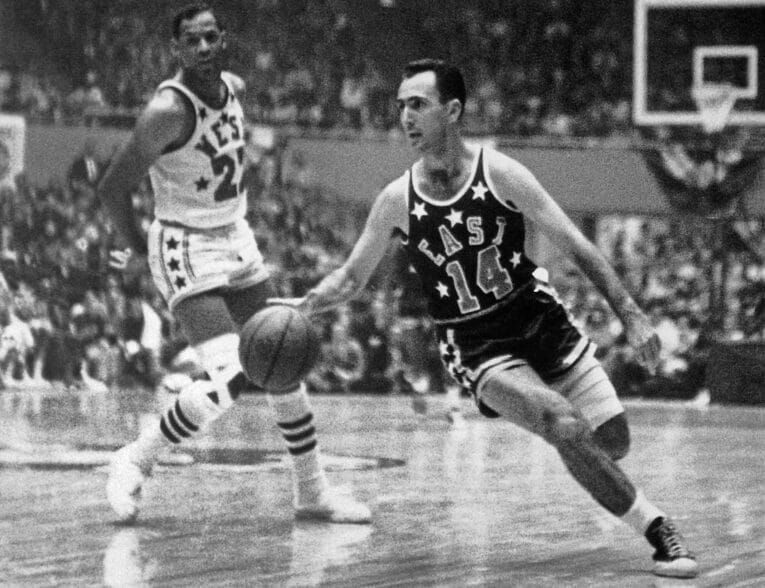
Bostonians curious what all the fuss was about for this inaugural All-Star Game had two choices on the evening of Friday, March 2, 1951.
Option one: fork out $1.20 of their hard-earned money for a reserved seat at Boston Garden. Option two: stay home and listen to the game on WHDH – that’s 850 on your AM dial – with tip set for 9 p.m. There was no television, no throng of news media in attendance, no line snaking around the building emanating from the box office window (in fact, seats remained available as the game commenced).
From the Converse film, we meet the first All-Stars in league history.
Inside, however, there was a genuine snapshot of the times.
The preliminary was a high school game. The pregame introductions saw the players run out through a hoop. The ceremonial toss was done by a fella named Oswald Tower, who had been an influential rule-maker since the game’s adolescence. One coach, Joe Lapchick, was a famed barnstormer; the other, John Kundla, was in the process of piloting pro basketball’s first dynasty.
On the court, there were icons, both established and in-waiting: Mikan and Davies and Fulks and Schayes and a rookie named Cousy, already ways removed from being a name drawn reluctantly from a hat. The East wore white, the West blue, 10 stars on each the front and back of their uniforms for a total of 20 – one for each of the men ready to play their way into history.
The East wound up winning comfortably. Dolph Schayes recorded the first hoop, Ed Macauley the first memory – scoring 20 points and reducing George Mikan’s might. It would be several years before he was deemed the game’s Most Valuable Player, and he remains the only one not anointed as such at the time the game was played.
Perhaps more importantly, the game was by all accounts a raging success. Brown had not only put on an entertaining spectacle, but he had turned a profit. Podoloff, no longer a skeptic, was already fielding offers from other team governors eager to host the encore in 1952.
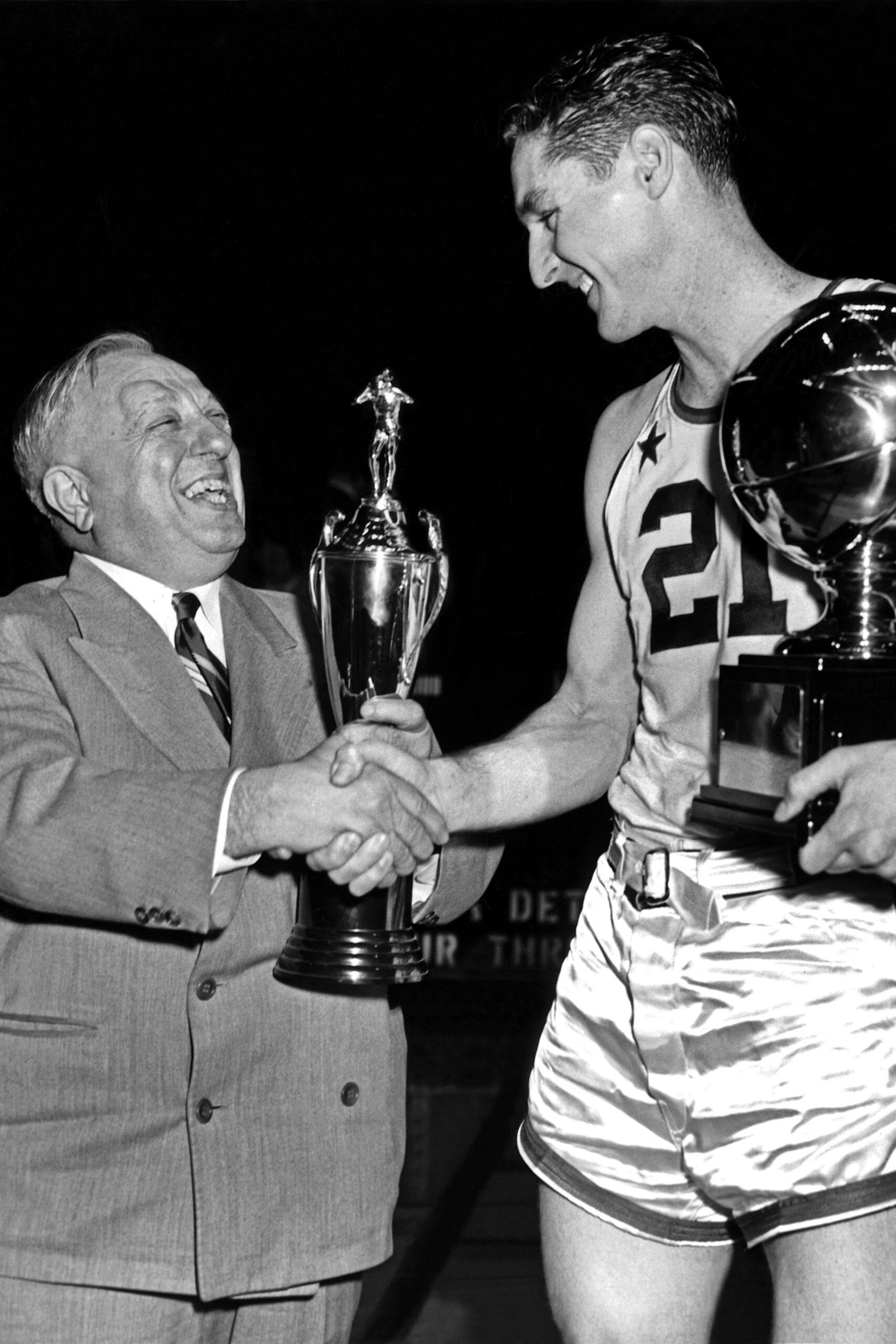
Enough minutiae about this historic occasion – let’s get to the film already, and this is a gem. We see Podoloff and Brown talking business. We meet the stars of the day in the locker room. Then we venture out onto the floor, where the game’s best players kick-started a tradition.
Combining rarely-seen footage from the 1954 All-Star banquet with the exciting final moments of the game.
With the All-Star Game entrenched as a yearly fixture, it finally made its way to the Big Apple for its fourth edition in 1954. The league, at the time hurting from stalled, foul-marred games and, subsequently, a frustrated fan following, needed a most spectacular diversion. And before a record crowd at the old Madison Square Garden, the players – the game – delivered.
Drama was not in short supply: 24 lead changes and 11 ties; MVP votes submitted on two occasions (apologies to the great Jim Pollard, the winner when ballots were first cast); the biggest name in the game – Mikan – at the free throw line with no time left in regulation; and the game’s next influential star – Cousy – taking over when it mattered, scoring 10 in overtime to secure the win for the East and earn MVP.
What did it all look like? First, we are going to stop by Toots Shor’s Restaurant on West 51st Street for the gameday function, dine on steak and baked potatoes, and pose for pictures. Then, we turn to a beautiful old film that shows the exciting final minute of regulation, when the clutch heroics of Bob Davies and Cousy set the stage for Mikan, who provided us with one of the first true, thrilling moving images in NBA history.
Mikan’s moment in the clutch had only earned the West the right to play five more minutes, and ultimately came in vain thanks to Cousy’s brilliance. Fast forward 18 years, and basketball’s latest and greatest late-game virtuoso – Jerry West – was set to serve as host as the All-Star Game was welcomed to Inglewood’s most Fabulous Forum.
It had been just nine days earlier that West’s Lakers had seen their 65-day, 33-game stretch of flawless hoops come to a spectacular halt at the hands of the defending champion Milwaukee Bucks. But it mattered little, for something mystical and unprecedented appeared to be taking place in 1971-72, with West seemingly reborn under new coach Bill Sharman, his game remastered and his influence even greater.
The timing was right for West to have his All-Star moment. For a player famously short on luck, that season it all appeared to be changing. Would it be too much to ask to have a tied score in the All-Star Game, in front of the home folks, mere seconds remaining, and the ball in the hands of Mr. Clutch? In January of 1972, that was not too much at all – and the basketball gods made it happen. All West – name on front, name on back – had to do was deliver, and to the narration of Chick Hearn, through the lens of this rarely-seen film, let’s see him do just that in this recap of the 1972 classic.
Recap of Jerry West’s heroics in the 1972 All-Star game via the Lakers year-end film.
When adjudging the finest of All-Star tales, the standard which to measure it against is that of Adrian Smith. His MVP triumph in the 1966 game remains the most improbable, for few of the other 54 men to have claimed the honor across 75 years have taken a journey to the All-Star Game quite like ‘Odie’s.’
He landed at Kentucky only after a stint in junior college; was overlooked for the 1958 draft; a handwritten letter got him to camp with the Royals prior to 1958-59, but nothing more, and he was cut after eight days; and he was a mere alternate for the 1959 US Pan-Am team before being the last add to the 1960 Olympic team while still a serviceman.
The Royals took a second look at him in October of 1961 after a stint in an industrial league, and a determined Smith made the most of a renewed opportunity. By 1965-66, he was Oscar Robertson’s most trusted backcourt associate – think John Paxson as an accompaniment to Michael Jordan.
A career year was not enough to be selected by the media for an All-Star spot, but league rules at the time dictated that conference coaches could choose the final two for the respective squads. By 3-1 margin over New York’s Dick Barnett, Smith got a berth to play in front of the Cincinnati faithful.
When the East was introduced, they were done so alphabetically: Robertson… Russell… Smith. He’d landed in the big time. With 24 points in 26 minutes, he’d created an All-Star memory. And you won’t believe the prize he won. Here is the complete story of Smith’s unlikely performance, the legend of a timeless automobile, and about never letting go.
A look back at Adrian Smith’s All-Star MVP effort with this vintage Inside Stuff feature from 1995.
In vehicular terms: let’s go from a Ford Galaxie convertible in 1966, to a Chevrolet Monte Carlo in 1978. That was the prize on offer as the All-Star Game made its way to Atlanta. Another Smith came from the clouds that Sunday afternoon, Randy was his name, and like Adrian, his odds of even carving out an NBA career were too once incalculable. When the Braves made the local Buffalo State star a cute seventh-round choice in 1971, Randy Smith was as well known for his exploits on the soccer pitch and the athletic track as he was on the hardwood.
But this Smith quickly proved himself to be one of the most athletic guards ever. He was indefatigable, historically durable, and without peer for speed and leaping ability for those his size. A perennial improver, by the mid-1970s he was an All-Star with the Braves, and 1978 represented his second appearance.
In the week leading to the game, the East had seen injured backcourtmen replaced with forwards, and coach Billy Cunningham desperately needed a lead guard. Despite a sizeable West advantage heading to the final stanza, Smith proceeded to deliver one of the most memorable All-Star performances on record: 27 points, 14 in the fourth, including 12 consecutively, while leading an East comeback against a heavily-favored West.
With the Clippers playing host to All-Star 2026, there’s no better time to look back on this effort from a true franchise ancestor. And we are confident you have never seen this before. We are at the Omni in Atlanta, Cunningham is mic’d up, the East are making a rally, and Randy Smith is about to break loose.
Courtesy of the league’s All-Star film, Randy Smith takes over down the stretch to lead the East.
Consider the scene at 3:21 p.m. PT on Sunday, February 8, 1987. Tom Chambers is standing in the center of a dome containing 34,000 people, there are millions more watching on television, and he is holding a trophy above his head following one of the greatest All-Star Games ever. As recent as five days prior, that scenario itself was impossible, and the chronology leading to this most unexpected, most glorious occurrence is as captivating as his performance.
18 days earlier, on January 21, the league released the voting results for its starters in the All-Star Game. Not only does Chambers not feature, he does not finish in the top 10 for West forwards. On January 26, the reserves are announced as chosen by the conference coaches. No Chambers. February 3, the top vote-getter for forwards in the West, Ralph Sampson, is injured, and the following day, commissioner David Stern announces Chambers as his replacement. The game is four days away.
What followed now resides in All-Star lore. West coach Pat Riley took the replacement and made him a starter, and the host city’s only representation took his place in a game of immortals. It became one of many subtexts to what quickly amounted to a classic. Julius Erving was making his All-Star farewell. Rolando Blackman showed cool under pressure. And Chambers elevated to an unexpected central role in one of the most unforgettable All-Star Games ever. Relive it all through this vintage feature.
Hometown hero Tom Chambers wins MVP in 1987 during a classic NBA All-Star Game in Seattle.
No two players have ever quite captured the All-Star spirit like Isiah Thomas and Magic Johnson. When sharing a court, as they did nine times opposed to one another in All-Star competition, they operated on the proviso that there was always another level the game could climb to. That they both had the ability to take it there at a moment’s notice made their unique mutual arrangement all the more exciting. With the next push of the ball, the next no-look bullet, they could serve as the crest on which the entire contest rode.
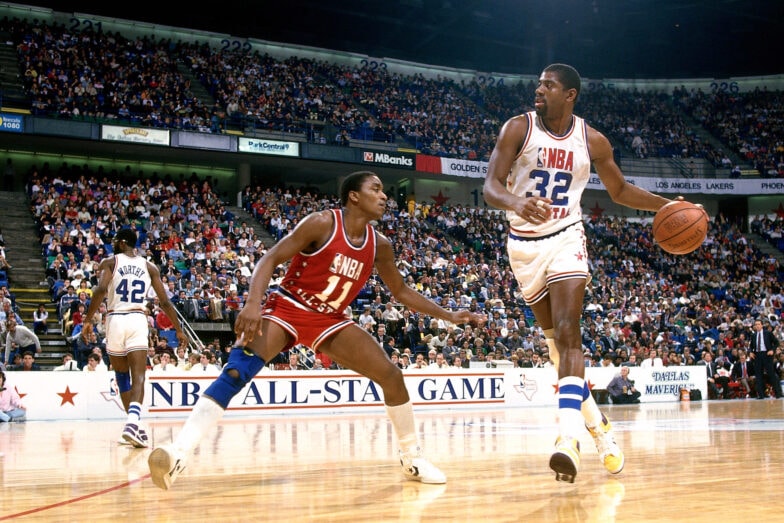
For Thomas, 1986 should rightly be remembered as his All-Star magnum opus. His fearlessness resigned the West defense to the fact that he could gain access to the paint at his choosing, and once there, he created wonders. Inspiring an East comeback, taking over the fourth, earning a second All-Star MVP – each in their own right reinforced his standing within the game. But what is perhaps most understated about this effort was the grander realization it gave Thomas, what possibilities it opened in his mind, all of which he outlines in this wonderful lookback.
Winning 1986 All-Star MVP was a watershed moment for Isiah Thomas, as he explains in this home video feature.
For Johnson, his ultimate and lasting gift to the All-Star Game came in Orlando in 1992. The circumstances surrounding that performance are well-versed to fans both dedicated and casual: a sudden and saddening retirement in November 1991 prefaced a one-off return the following February.
But what is easy to take for granted is what happened in between: despite not having played a game since the preseason, despite so little being known about his health and well-being, fans still demanded his presence that afternoon by voting in numbers. One can reasonably conclude that those votes were submitted with nothing more than hope, hope that he would conduct one final All-Star masterpiece.
The league agreed he should be there, and Johnson’s involvement became outsized within the context of the event. This was bigger than a game. To first deliver a performance, then a moment – simply put, there’s never been another All-Star Game like it.
What you’re about to view puts a whole new twist on that Magical afternoon: we see Johnson arrive, from limousine to locker room, we gain insight into his feelings pregame, and then observe his performance from rarely-seen vantage points. This is Magic Johnson’s 1992 All-Star experience as you’ve never enjoyed it.
Through a rarely-seen home video, go behind-the-scenes for Magic Johnson’s dramatic return in the 1992 All-Star Game.
The 1996 game again saw a celebrated return from one of the All-Star grand masters, though this one elicited emotion of a different kind. Three years removed from his last appearance at the event, Michael Jordan’s reemergence into our basketball lives felt more like Deja Vu: the Bulls were back in first place, and Jordan was back as the game’s best player.
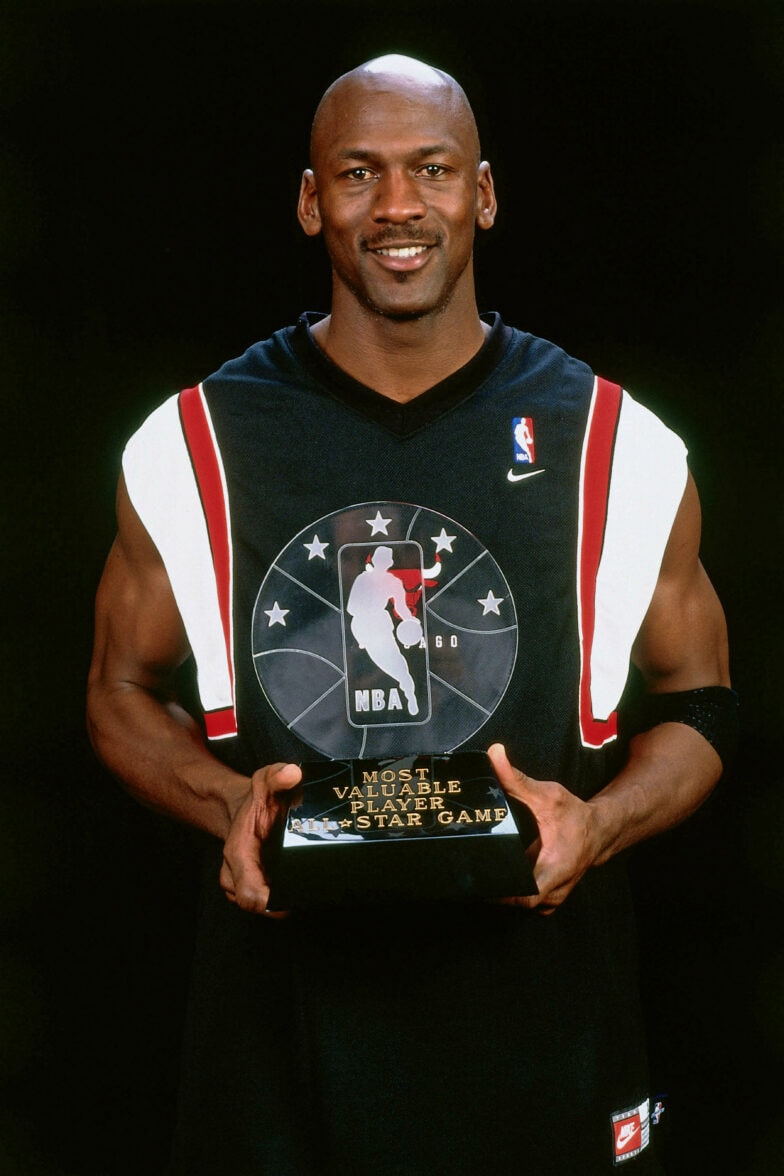
The All-Star guest list in San Antonio still included eight Dream Teamers, and we would be remiss to not acknowledge dignitaries named Olajuwon, O’Neal, Kemp, Hardaway, Payton, Kidd or Hill. Need I continue? The competition on both sides was fierce, NBC was there to capture every move, and there was a dome full of people revelling in it.
And Jordan remained the hub of it all; his specter looming over all proceedings. This weekend, this game, was all about him, and all he needed was 22 minutes to seize control and earn the MVP.
In this fantastic behind-the-scenes recap, we go inside both locker rooms, we hear Grant Hill talking about All-Star nerves, Gary Payton barking instructions, and go everywhere Jordan goes – including out on the floor. This is 1990s hoops at its coolest, All-Star style.
Go behind the scenes at the 1996 All-Star Game with Jordan, Payton, Hill and others in this classic NBA Action feature.
Need more from the 90s that makes you feel like you’re there? Great. Let’s move on to 1997 in Cleveland. The NBA at 50 celebrations made that season the most nostalgia-driven in league history, and All-Star Weekend featured a collection of basketball royalty in one place that is unlikely to be replicated. There was near-perfect attendance from the 50 greatest players; the modern greats were out in force for the All-Star Game; even the Rookie Game, populated by the Class of 1996, showcased future MVPs and Hall of Famers. For a weekend, Gund Arena became the living, breathing, walking, talking Basketball Hall of Fame.
We’re going back behind the scenes again for more throwback delights. Jordan and Dikembe Mutombo are still debating their battles at the rim. Inside the huddles, former All-Stars Doug Collins and Rudy Tomjanovich are leading their respective conferences. Yes, more players are mic’d up. And it was only fitting that the MVP, Glen Rice, put together a record-setting effort for this historic occasion.
Go behind the scenes at the 1997 All-Star Game with Jordan, Garnett, Brandon and others in this classic NBA Action feature.
So much about that Cleveland All-Star experience was centered on the past, the founding fathers, and acknowledging the bedrock on which the league proudly stood. But that weekend, there too was a revelation gaining in momentum; a sharp nod to the unwritten. Allen Iverson (coached by Red Auerbach!) boldly took MVP honors in the Rookie Game. Kobe Bryant made one of his first national statements in the dunk contest. And Kevin Garnett was not yet a superstar when he earned selection for that All-Star Game, his first, barely 120 games removed from a celebrated high school career. That KG broke through to the main game when he did, with greats of yesteryear watching and those of modern times far from ready to hand the mantle, is something for posterity.
The access to what you’re about to watch makes it all the more incredible – a genuine snapshot in time. This is Garnett’s maiden All-Star experience – the first of his 15 – from arrival to departure: he shares how he found out he made the team; how he took in All-Star Saturday; and, best of all, he is mic’d up for the game. Sit back and enjoy this genuine vault gem.
From arrival to departure, relive every step of Kevin Garnett’s 1997 All-Star debut with this behind-the-scenes feature from Inside Stuff.
If the task is to piece together a list of the greatest rookie seasons in league history, consider this an automatic first ballot selection. Tim Duncan’s 1998 announcement of arrival: All-NBA first team (the first rookie since Larry Bird), top five finishes in the MVP and Defensive Player of the Year, 21 and 12 on a nightly basis, and the majority stakeholder in San Antonio’s 36-win turnaround that went deeper than just the addition of a number one pick.
But it’s another of Duncan’s accomplishments that year – All-Star – which gets the shine here. We experienced Garnett’s first All-Star experience, now journey through Duncan’s. The game had returned to New York after a 30-year absence. Fans were anticipating the collision course between Jordan and Bryant. And one of the best rookies this league has ever seen was taking his first All-Star steps.
From arrival to departure, relive every step of Tim Duncan’s 1998 All-Star debut with this behind-the-scenes feature from Inside Stuff.
As far as All-Star miracles go, it remains unsurpassed. 2001. Washington, D.C. The power gap between conferences never felt so wide – the West had the size, the talent, and the titles. The East, on paper, was guard-heavy, and in the lead-up, was forced to exercise three injury replacements while starting four forwards alongside Allen Iverson. Though AI was enjoying his undisputed apex, as the East’s leader, he also inadvertently symbolized their plight: this absolutely was David versus Goliath.
The game played out as expected. The West scored the first 11 points unanswered. Through one period, they were up 13; through three, it was 19. At 9:08 remaining, the low point: West 95, East 74. It was getting ugly. But then something happened. Mutombo, through sheer enthusiasm, seemingly garnered every rebound (he finished with 22) and inspired his teammates to defend.
Iverson began invading the West defense in his own bombastic way, scoring 15 of his 25 in the period. With the West lead reducing rapidly, coach Larry Brown, himself once an overcomer-of-odds of the diminutive variety, he turned to the other of the East’s munchkins, Stephon Marbury. Without a hint of hesitation, twice in the final minute Marbury launched from the outside with the East in deficit – and canned both. The East stood tall on the West’s final, frightful possession, holding on for dear life, and their post-buzzer reaction showed how much it meant.
This is the ideal All-Star memory to depart on, one in which words only tell a fraction of the story. In this awesome access piece that has not been seen since its original airing 25 years ago, relive that unforgettable All-Star Game through the sights and sounds on the floor.
Check out the East’s amazing 2001 comeback against the West from rarely-seen vantage points with this long-forgotten Rewind feature from Inside Stuff.